

A company's success depends largely on how effectively its operations are organized and managed. In this context, business rules play an essential role: they define how decisions should be made, which conditions must be met, and how the organization should respond to different situations.
A business rule may establish, for example, that purchases above a certain amount require managerial approval, that an order can only be invoiced after payment confirmation, or that a task must undergo a validation step before it can be completed.
When these rules are not properly documented, knowledge tends to remain concentrated among specific employees, be passed on informally, or be interpreted differently across the organization. This can result in uncertainty, errors, rework, and difficulties when improving business processes.
Why Is It Important to Document Business Rules?
Documenting business rules turns informal knowledge into clear, accessible, and verifiable guidance. This practice helps standardize activities and enables the organization to maintain consistent processes, even as the team changes or the business grows.
The main benefits include:
- Greater consistency: everyone follows the same guidelines, reducing conflicting interpretations and inconsistent decisions.
- Improved communication: documented rules help align managers, employees, customers, suppliers, and other stakeholders.
- Better decision-making: those responsible for a decision can consult previously established criteria before approving, rejecting, or forwarding an activity.
- Fewer errors and less rework: clear rules reduce reliance on memory and help prevent important steps from being overlooked.
- Knowledge preservation: essential information remains available even when an employee changes roles or leaves the company.
- Support for compliance: documentation helps demonstrate how the organization applies specific procedures and controls.
What Happens When Business Rules Are Not Documented?
When business rules exist only as part of everyday practice or in the knowledge of a few individuals, the organization becomes more vulnerable to operational failures. The same situation may be handled differently depending on who performs the activity.
Common consequences include:
- More errors: without clear criteria, decisions may be based on assumptions or incomplete information.
- Lower productivity: employees spend more time requesting guidance or correcting activities that were performed incorrectly.
- Training difficulties: new team members take longer to understand processes and become overly dependent on experienced colleagues.
- Loss of knowledge: valuable information may disappear when someone leaves the team.
- Damaged relationships: inconsistent decisions can undermine trust among customers, partners, and suppliers.
- Difficulty improving processes: processes that are not clearly defined are harder to analyze, measure, and optimize.
How Can Business Rules Be Connected to Processes?
An isolated rule can be difficult to interpret. In addition to documenting the rule itself, it is important to identify the process, activity, or decision in which it must be applied.
Consider the following rule: “Orders with discounts greater than 15% must be approved by the sales manager.” In a modeled process, this condition can be associated with the order approval stage, clearly indicating when the rule must be checked, who is responsible, and which path the process should follow after the decision.
Business Process Model and Notation (BPMN) makes it possible to represent activities, decisions, responsibilities, and workflows visually. When this process view is combined with task and deadline management, documentation becomes an active part of the operation rather than merely a static record.
How Can Kanbada Help?
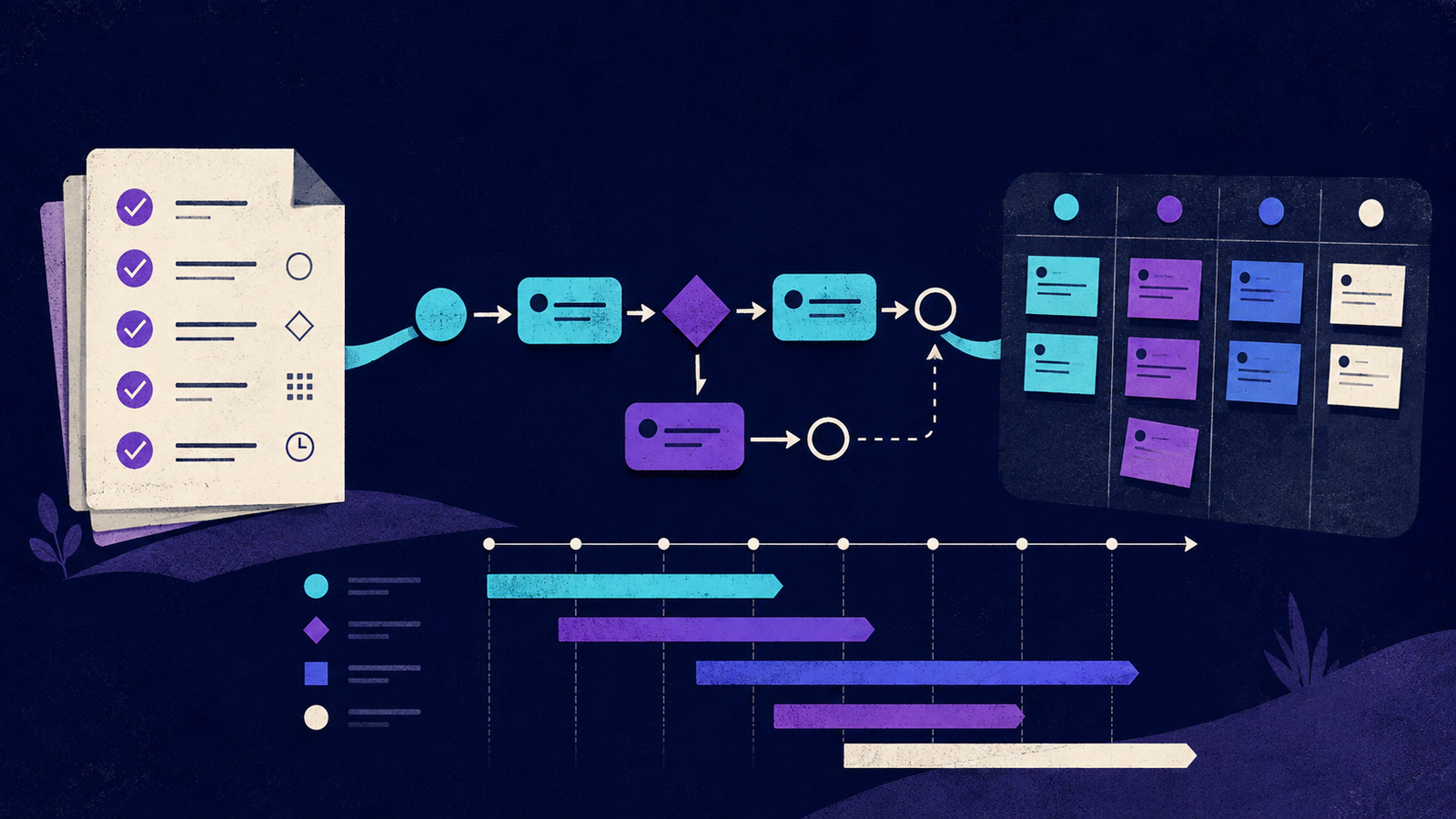
Kanbada integrates Kanban, Gantt, and BPMN into a single platform, connecting process documentation with work planning and execution.
With Kanbada, your organization can:
- Model business processes and workflows using BPMN diagrams.
- Document business rules, requirements, restrictions, objectives, inputs, and outputs related to modeled processes.
- Connect process elements with the tasks performed by the team.
- Assign responsibilities and monitor activities using Kanban boards.
- Plan schedules, dependencies, and project stages using Gantt charts.
- Centralize essential information to make consultation and collaboration easier.
This integration brings planned processes closer to the work performed every day. Team members can understand not only what needs to be done, but also how, when, and under which rules each activity should be carried out.
Turn Business Rules into Clearer Processes
Documenting business rules is an important step toward reducing errors, preserving organizational knowledge, and making operations more predictable. However, the greatest benefit comes when these rules are connected to business processes, responsibilities, and daily activities.
By integrating BPMN, Kanban, and Gantt, Kanbada provides a more complete view of work: processes can be modeled, business rules documented, tasks monitored, and deadlines planned within the same environment.